
Something strange happened to the mining sector in the opening months of this year. Bitcoin itself slid roughly seventeen percent on rising Treasury yields and hawkish central bank expectations, while a tracked basket of crypto mining equities climbed fifty-six percent over the same stretch. Individual names did far better, with TeraWulf gaining more than seventy-three percent. For an industry whose fortunes were supposed to rise and fall with the coin it produces, that decoupling is remarkable, and the market was saying something plain: these are no longer Bitcoin companies. They are becoming data center operators that happen to still mine on the side.
The scale of the shift is easier to grasp through contracts than through stock charts. More than seventy billion dollars in cumulative artificial intelligence and high-performance computing agreements have now been announced across the public mining sector. Hut 8 signed a fifteen-year lease worth billions for a Texas facility built to NVIDIA reference architecture. TeraWulf locked in nearly thirteen billion dollars of contracted revenue. IREN secured a deal with Microsoft covering seventy-six thousand GPUs, and CoreWeave expanded its arrangement with Core Scientific into a twelve-year commitment worth over ten billion. Some miners have gone further still: Bitfarms announced it would wind down mining entirely and convert its sites, beginning with an eighteen-megawatt facility being rebuilt to support up to a hundred and ninety kilowatts per rack with advanced liquid cooling.
Why this is happening comes down to arithmetic that has turned brutal. Electricity accounts for as much as ninety percent of a miner’s operating cost, and wholesale prices in the United States have been climbing toward fifty-one dollars per megawatt-hour. Full production cost per coin averaged roughly seventy-four thousand dollars at the start of the year, with the electricity component alone approaching forty-six thousand by spring. Margins compressed further as network difficulty rose after the last halving. Against that backdrop, the comparison that matters is revenue per megawatt. HIVE has estimated that ten megawatts of H100 infrastructure can produce revenue comparable to a hundred megawatts of Bitcoin mining capacity. Companies executing on signed AI deals report operating margins in the range of eighty to ninety percent, a figure that mining has not seen in years.
What makes miners unusually well positioned is that they already own the hardest thing to acquire. Large-scale power infrastructure, physical data center shells, cooling systems, and above all high-voltage grid interconnects take years to secure, and miners spent the last decade securing them. Building a new hyperscale campus from bare land means waiting in an interconnection queue that stretches well beyond most investment horizons. The incremental cost of repurposing an existing mining facility is substantially lower than starting fresh, which is precisely why the conversion trade has moved from experimental to a recognized revenue line on quarterly reports.
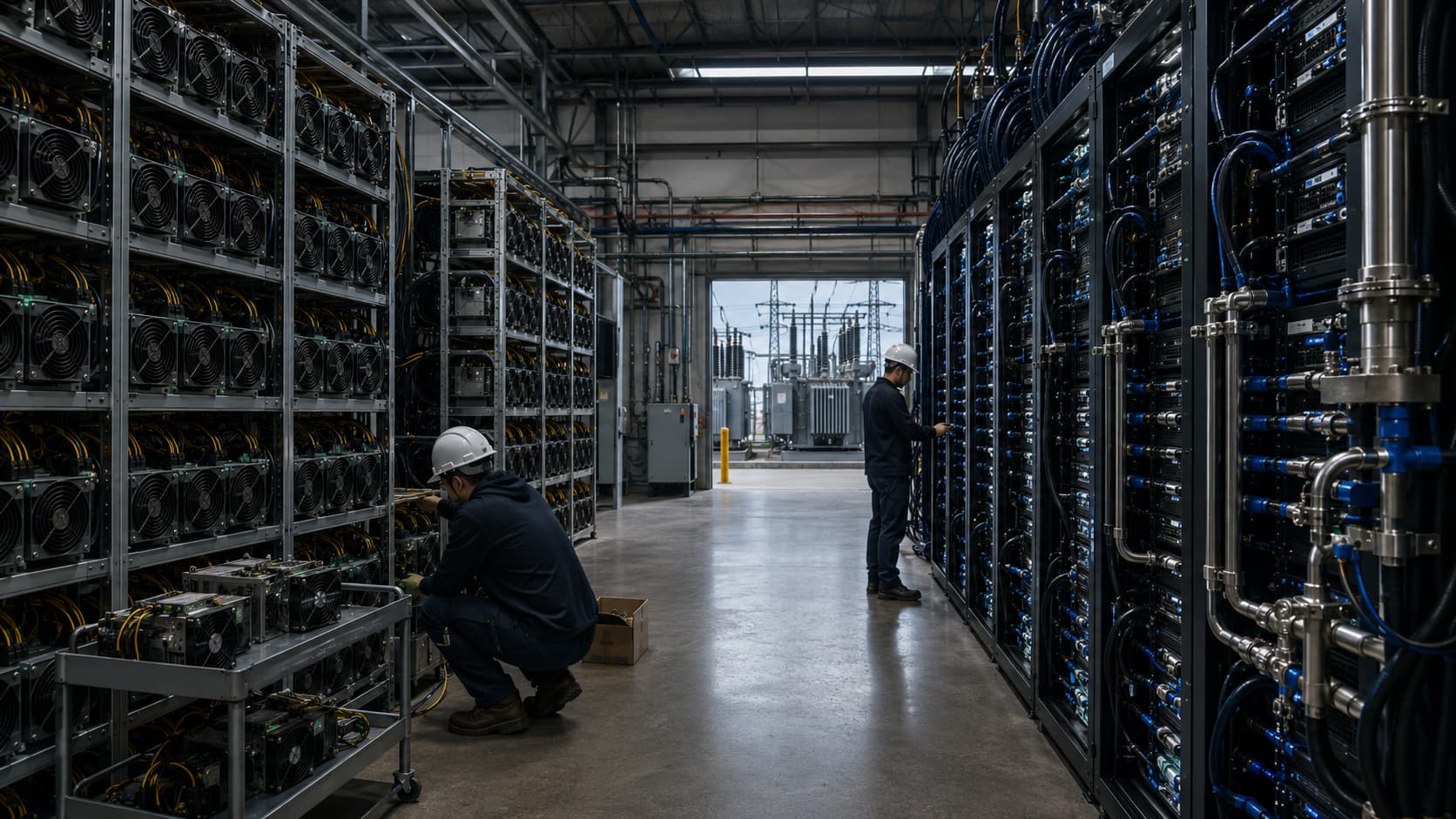
The catch is that the two workloads are far less compatible than the shared word “data center” suggests. A mining hall is engineered for cheap air cooling, tolerant of temperature swings and indifferent to individual machine failures, since losing a few units barely dents total hashrate. An AI training cluster demands the opposite: uninterrupted power, redundancy, low-latency high-speed optical interconnect between racks, and thermal management of a completely different order. The arrival of NVIDIA’s Blackwell platform, drawing up to a hundred and twenty kilowatts per rack, rendered traditional data hall designs effectively obsolete. Miners are not simply swapping ASICs for GPUs; they are gutting existing air-cooled halls to install the plumbing that liquid cooling requires. Not every site can survive that surgery, and the ones that can tend to be the operators with contiguous land and pre-existing high-voltage connections rather than the smaller players.
Execution risk separates the announcement from the revenue. IREN, for example, is already running twenty-three thousand GPUs, which demonstrates it can handle hardware management complexity that other miners have so far only described in press releases. Operating a fleet of accelerators for demanding enterprise clients is a service business with uptime obligations, support expectations, and contractual penalties, none of which resemble the fire-and-forget economics of hashing. A miner that has never had a customer must now learn to keep one.
There are consequences beyond the balance sheets. Global hashrate fell nearly six percent in the second quarter, and if capacity keeps migrating toward GPUs, the aggregate computational defense of the Bitcoin network thins while remaining concentrated among fewer operators. Funding the transition has its own cost: miners have sold more than fifteen thousand coins from corporate treasuries and taken on billions in debt to build out AI capacity, which means the sector is levering up against contracts that must actually be delivered. And at the grid level, combined energy demand from AI and crypto could exceed a thousand terawatt-hours, putting two enormous consumers in direct competition for power in regions where transmission upgrades move far slower than either industry.
For investors, the practical implication is that the old thesis no longer describes the asset. A miner deriving the majority of its revenue from long-term compute leases is not a leveraged bet on the coin price; it is an infrastructure landlord with a legacy mining division. Projections suggest listed miners could draw as much as seventy percent of revenue from AI by year end, up from roughly thirty percent, with Core Scientific already at thirty-nine percent and TeraWulf at twenty-seven. Those are different companies than the ones many portfolios bought. Whether the conversion proves durable depends on questions nobody can answer yet, chiefly whether AI compute demand holds through the buildout and whether power costs stabilize. What is no longer in doubt is that the industry has stopped treating a megawatt as something you spend on hashing and started treating it as something you sell to the highest bidder.