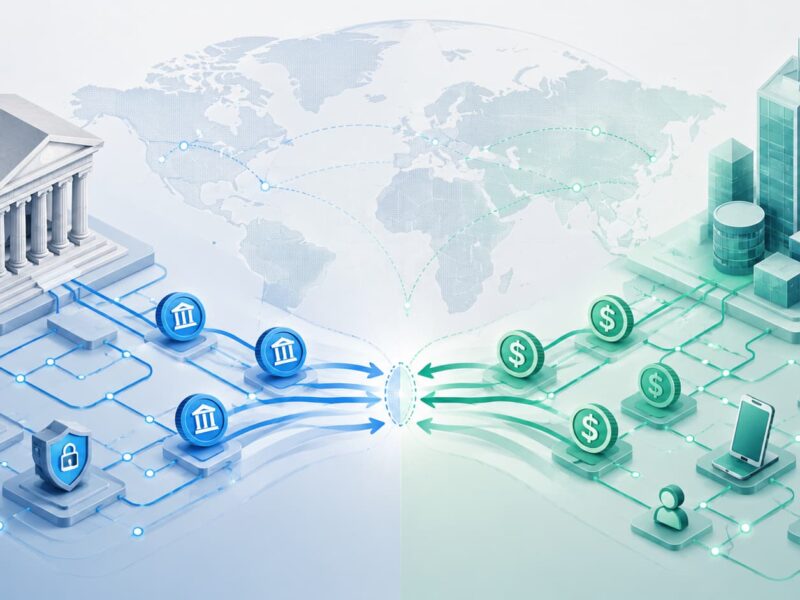

For most of crypto’s history, the assets on a blockchain were native to it: bitcoin, ether and thousands of tokens that existed only in digital form. In 2026 that is changing fast. Government bonds, gold, private credit, real estate and even shares are being turned into tokens that can be held in a digital wallet and transferred around the clock. This process, known as real-world asset (RWA) tokenization, has become one of the few blockchain trends embraced by both crypto natives and the world’s largest asset managers.
What Is Real-World Asset Tokenization?
Tokenization means creating a digital token on a blockchain that represents a legal claim on an asset held in the real world. A fund might hold US Treasury bills with a regulated custodian and issue one token per share of the fund. Owners of those tokens receive the yield from the bills, just as with a traditional fund, but they can transfer or use the tokens on-chain.
The idea is not to replace the underlying asset but to change how ownership is recorded, transferred and settled.
The Market in Numbers
According to industry trackers, the tokenized RWA market (excluding stablecoins) grew from roughly $5.8 billion at the start of 2025 to more than $30 billion by late April 2026, an increase of over 400% in about sixteen months.
| Asset category | Approx. market size (spring 2026) | Key trend |
| Tokenized US Treasuries | $15 billion+ | Largest segment, driven by institutional funds |
| Gold-backed tokens | About $5.5 billion | Record trading volumes in Q1 2026 |
| Tokenized equities | About $0.5 billion | Rapid growth from almost zero |
| Tokenized ETF products | About $0.3 billion | Early but expanding |
| Private credit and real estate | Growing niche | Fractional access to illiquid assets |
Treasury products are the clear leader because they offer a simple, familiar yield in a form that works on-chain. Gold tokens, meanwhile, recorded around $90 billion in spot trading volume in the first quarter of 2026 alone, more than in the whole of 2025.
Who Is Leading the Market?
- BlackRock launched its BUIDL fund in March 2024, giving on-chain access to US government debt and signalling that tokenization had reached Wall Street.
- Fidelity followed with its own tokenized money-market product in September 2025.
- Franklin Templeton, Ondo Finance and others offer tokenized treasury and money-market funds across several blockchains.
- Gold issuers such as Paxos (PAXG) and Tether (XAUT) dominate tokenized commodities.
Why Investors Care: The Main Benefits
- 24/7 settlement. Tokens can move at any hour, instead of waiting days for traditional settlement.
- Fractional ownership. A building or private-credit portfolio can be split into small units, opening assets once reserved for institutions.
- Transparency. Ownership and transfers are recorded on a public or permissioned ledger.
- Programmability. Tokens can be used as collateral in DeFi protocols or pay out income automatically through smart contracts.
- Global reach. Investors in different countries can access the same product through a digital wallet, subject to local rules.
The Risks and Open Questions
Tokenization does not remove traditional risks; it adds some new ones. Investors should consider:
- Legal enforceability: the token is only as strong as the legal structure linking it to the asset.
- Custody and counterparty risk: someone still has to hold the real bonds, gold or property.
- Smart contract and bridge risk: code bugs and cross-chain exploits remain a threat.
- Liquidity: many tokens can be transferred freely in theory but have few buyers in practice.
- Regulation: rules differ by country, and many products are limited to verified or accredited investors.
Tokenization Beyond Finance
The most successful tokenized asset of all is arguably the stablecoin, a token backed by dollars or other reserves. Stablecoins have shown how tokenized value can spread into everyday digital life. Beyond banking and investment, industries such as airline loyalty programmes, event ticketing, video games and digital entertainment are experimenting with tokens for payments, rewards and ownership records. A music platform might issue tokenized fan rewards, while an Online Casino or sports platform may accept stablecoin deposits for faster international payments. These consumer-facing uses are smaller than the treasury market, but they bring tokenization to millions of ordinary users and will shape how people think about digital ownership.
What to Expect Next
Forecasts for the sector vary widely, with some analysts projecting that tokenized assets could reach trillions of dollars by the end of the decade. Whatever the exact figure, several trends look likely:
- More traditional asset managers launching on-chain versions of existing funds.
- Growth of tokenized equities and ETFs as regulation becomes clearer.
- Deeper integration with DeFi, where tokenized treasuries act as low-risk collateral.
- Interoperability standards that let tokens move between institutional and public blockchains.
How Individual Investors Can Get Exposure
Direct access to institutional products like BUIDL usually requires large minimum investments and verification, but retail options are expanding. Tokenized gold can be bought in small amounts on major exchanges, several platforms offer fractional real estate tokens, and some brokers now provide tokenized versions of popular stocks in selected regions. Before buying, check who issues the token, where the underlying asset is held, whether regular audits or attestations are published, and how you can redeem the token for the real asset or its cash value.
Final Thoughts
Real-world asset tokenization has moved from white papers to working products worth tens of billions of dollars. For investors, it offers faster settlement, broader access and new ways to use traditional assets. It also demands careful due diligence on legal structures, custodians and technology. As 2026 shows, the future of blockchain may be less about replacing finance and more about rebuilding its plumbing.